How Fat Temperature Controls Flakiness vs. Tenderness
Every pastry recipe sits on a spectrum between short and crumbly (like a sandy jam tartlet) and flaky and laminated (like rough puff pastry). Both use the same three ingredients—flour, cold butter, and ice water—but they manipulate butter size completely differently.
When you rub butter thoroughly into flour until it looks like fine breadcrumbs, fat coats individual flour particles and waterproofs them against water. Gluten cannot form long chains, yielding a tender, melt-in-the-mouth shortcrust. Conversely, when you flatten walnut-sized cubes of cold butter between your thumb and fingers into thin wafers and fold the dough over itself twice like a business letter, you create distinct alternating sheets of butter and hydrated dough. In a 200°C (400°F) oven, the water inside those butter wafers flashes into steam, jacking the pastry layers apart into crisp, shattering flakes.
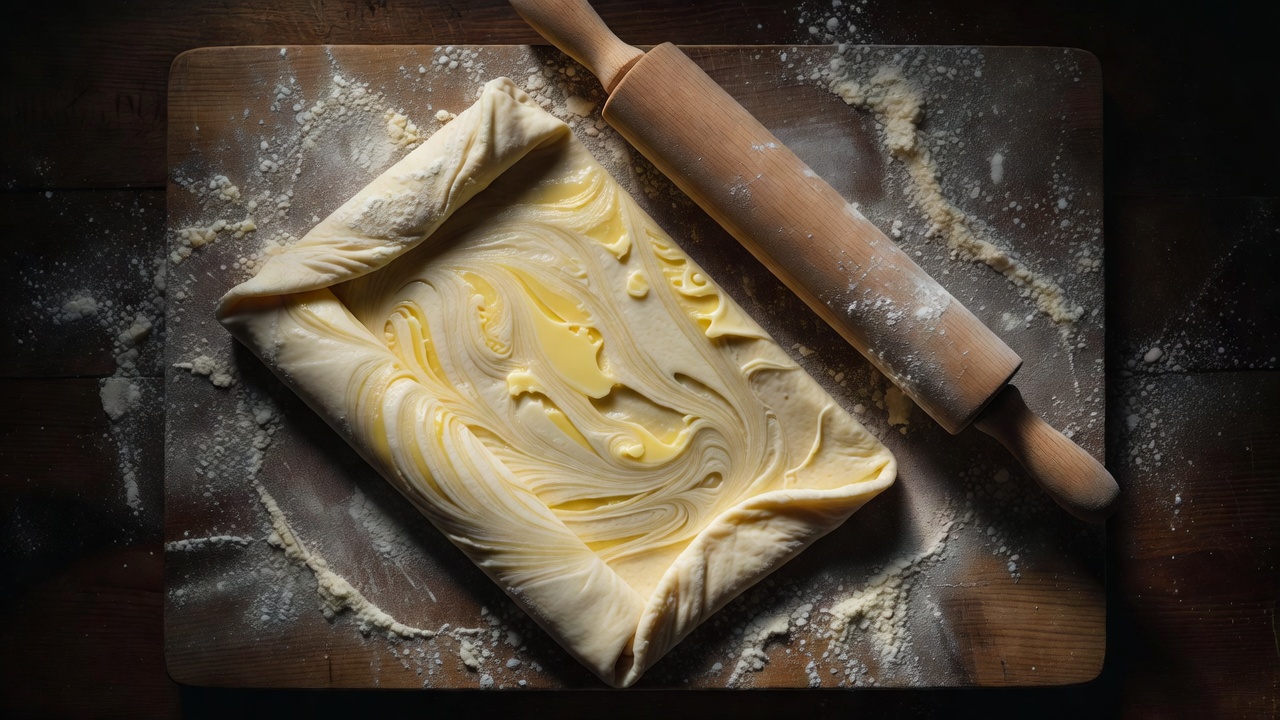
Recipe: All-Butter Spelt & Rye Galette Dough (Pâte Brisée Feuilletée)
Free-form galettes forgive uneven rolling and bake crisper on the bottom than deep metal pie tins because hot oven air circulates directly around the folded rim.
- 160g plain / all-purpose flour
- 65g wholegrain spelt or dark rye flour (adds nutty depth and reduces shrinkage)
- 15g caster sugar & 4g fine sea salt
- 175g cold unsalted butter (82% butterfat), cut into 1.5cm cubes
- 75g ice water mixed with 5g apple cider vinegar
Observable Cues: Toss the cold butter cubes in the dry flour mix, then flatten each cube firmly between your fingers into ragged, coin-thin flakes. Drizzle the ice water down the sides of the bowl and toss with a fork until shaggy clumps form. Tip onto the counter, press into a rough rectangle, and roll into a 30cm strip. Fold the top third down and the bottom third up like a letter. Rotate 90 degrees, roll out once more, and fold again. Wrap and chill for at least 1 hour so the gluten relaxes and the butter firms up.
Preventing a Soggy Bottom: Before piling sliced apples, pears, or roasted plums onto your rolled pastry circle, spread a 2-millimetre barrier of ground almonds, toasted hazelnuts, or crushed amaretti biscuits mixed with a spoonful of flour across the center. This nutty cushion drinks up released fruit juices while the bottom crust bakes crisp on a hot baking tray at 200°C (400°F) for 40–45 minutes.
"If the butter starts feeling greasy or sticking to your rolling pin, stop immediately and slide the baking sheet into the fridge for 12 minutes. Five minutes of chilling saves forty minutes of baking." — Bench Note #19, Summer Lamination Rules
Soft Enriched Bakes: The Tangzhong Secret for Morning Buns
Why do home-baked cinnamon or cardamom rolls sometimes turn dry by the next morning? Standard yeast dough loses moisture quickly as starch retrogrades during cooling. By cooking a tiny portion (about 6%) of the recipe's flour and milk in a small saucepan to 65°C (150°F) until it thickens into a pudding-like roux—a Japanese technique known as tangzhong or water roux—you pre-gelatinize the starches.
Once cooled to lukewarm and kneaded into your main dough alongside eggs, sugar, and soft butter, that tangzhong paste holds twice its weight in bound water. Your braided cardamom knots bake up pillowy, pull apart in feathery strands, and stay moist inside an airtight tin for three full days.
| Morning Pastry Style | Butter Handling Cue | Oven Temp | Key Doneness Signal |
|---|---|---|---|
| Rough Puff Fruit Galette | Cold 13°C flattened coins; visible marbled streaks after folding. | 200°C (400°F) | Deep golden blistered rim; fruit bubbling thickly in center; slides freely on parchment. |
| Tall Buttermilk Scones | Pea-sized cold pebbles rubbed lightly; minimal hand contact; cut straight down without twisting cutter. | 215°C (420°F) | Tall horizontal split ("the smile") dry and matte inside the crack; golden-brown tops. |
| Tangzhong Cardamom Knots | Room-temperature soft butter kneaded in after gluten develops so fat doesn't block hydration. | 205°C (400°F) | Short 12–14 min bake; internal temp 88°C (190°F) so buns remain cloud-soft rather than crusty. |
Next: Move from morning pastry to hearty savoury pies and evening oven suppers →